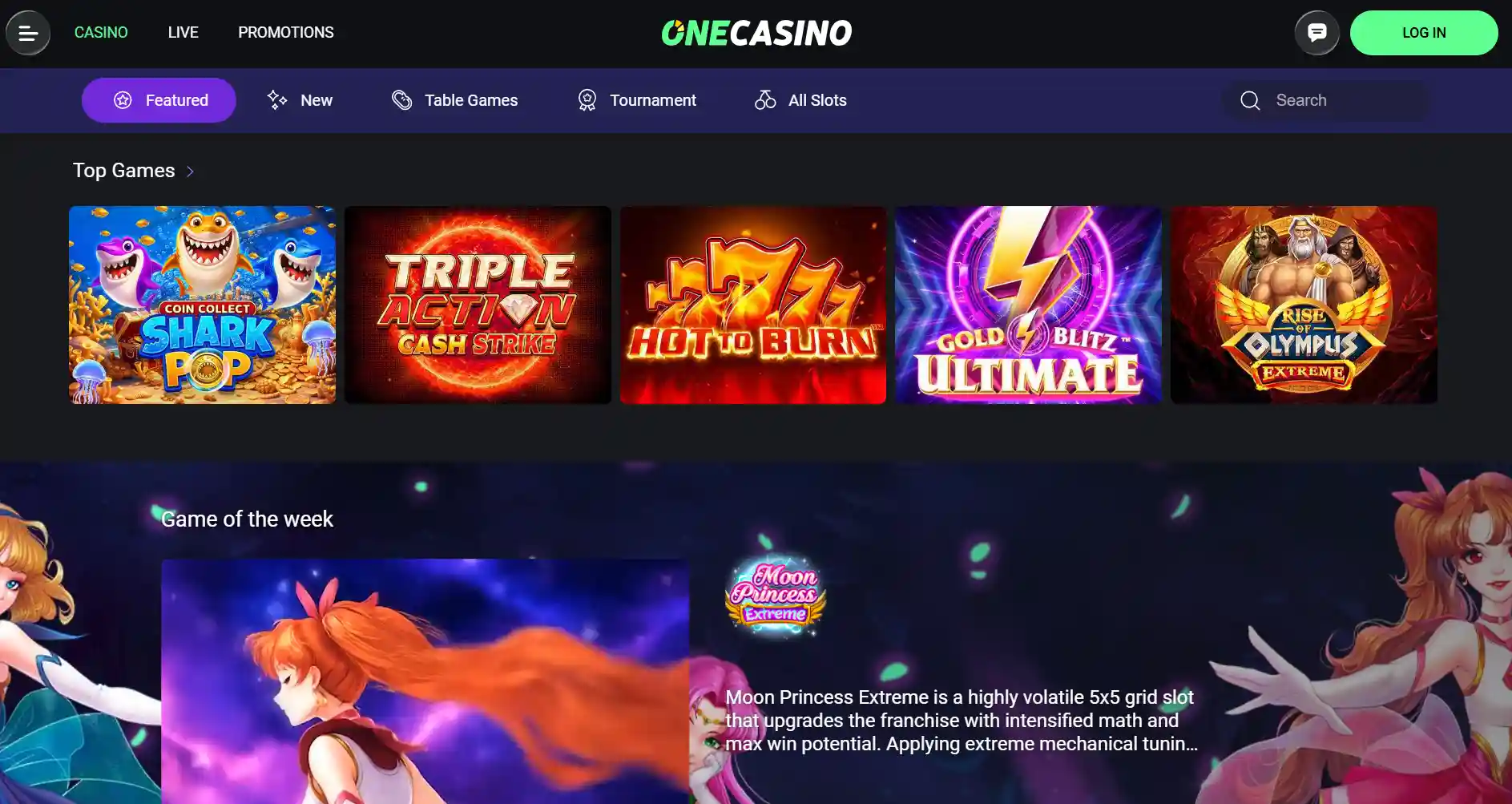
OneCasino licensing and Canadian registration
 Available in US
OneCasino operates through One Casino Limited and the onecasino.com domain. Its registered gambling authorisation comes from Malta, while registration from Canada presents a separate access question. That distinction affects who can open an account, how the operator’s terms apply and where a complaint can be directed. A published currency clause and an overseas gaming licence each answer part of the picture; neither replaces the rules governing access from Canada.
For an existing account dispute, the useful sequence is to identify the legal entity, preserve the relevant terms and transaction history, ask for a written explanation and then consider the dispute routes tied to the actual licence. The identity and account-control policies and the cashout process often provide the first documents required to understand a contested decision.
Table of Contents
- Canadian registration and availability
- A payment or account dispute needs a traceable record
- The Malta register connects the licence to onecasino.com
- Terms affecting winnings can become the centre of a complaint
- Maltese oversight and Canadian account rights are separate
- Questions about jurisdiction and complaints
- A traceable Malta licence does not establish Canadian access
Canadian registration and availability
AskGamblers currently lists Canada among the countries excluded from registration at OneCasino. OneCasino’s general terms nonetheless name CAD as a payment currency and describe a CAD 10 first-deposit condition before a first withdrawal for Canada. The two statements address different subjects: one is a third-party restriction listing and the other is a currency and withdrawal clause. The CAD wording therefore does not by itself establish that a Canadian resident can register.
OneCasino’s registration terms also prohibit applications from countries that are absent from the signup-country selector. This rule is substantive: a page loading in a browser, a familiar payment logo or a currency name cannot establish that a residence is accepted. The same country selection may also affect the game lobby, offers, funding routes and identity documents associated with an account. A country-specific payment reference is therefore not an assurance that those parts of the service are available to a Canadian resident.
Canadian gambling oversight is divided across provincial and territorial frameworks rather than a single countrywide online-casino approval list. A Maltese gambling licence therefore does not amount to Canadian nationwide permission. AskGamblers’ Canada restriction is a separate third-party listing and should not be treated as a decision by a Canadian regulator.
The relevant distinction: a registered gambling operator can possess an authentic licence and still restrict registrations from a particular country. The status of its licence and the status of a Canadian application are separate matters.
That distinction also matters after a disagreement. An individual considering a dispute should start with the jurisdiction and contract actually governing the account, instead of assuming access to a nationwide Canadian casino-complaint route. The complaint and account records become more valuable when registration jurisdiction, transaction currency and customer residence are clearly separated.
A payment or account dispute needs a traceable record
OneCasino lists customer support at [email protected], alongside a web help centre and live chat. Those channels are the first place for an explanation of a disputed withdrawal, document request or account decision. A support reply is different from a formally reasoned decision, so keeping the case number, the actual requested remedy and the operator’s response together is more useful than relying on a chat transcript in isolation.
The Maltese licence listing identifies eCOGRA as an alternative-dispute-resolution body. An ADR process may provide a separate route for a qualifying dispute under the applicable arrangement. It should not be treated as a Canadian regulator, a guarantee of recovery or evidence that a registration was allowed. The scope, admissibility and sequence of a complaint must follow the relevant ADR rules and account conditions.
Build the chronology before escalating
- Keep the governing version of the terms. Save relevant account rules, promotional conditions if applicable and any notices that accompanied the balance or withdrawal at issue. Identifying the terms that governed the event helps separate a later policy revision from the original decision.
- Preserve the payment trail. Record the amount, currency, payment instrument, transaction reference, submission time and any processing update. A rejected request, operator review and bank settlement are different stages with different explanations.
- Log account checks. Keep the dates of identity, address or payment-ownership requests, alongside confirmation of what was submitted. Redact unrelated sensitive information from copies shared outside a secure official process.
- Ask for the exact reason. Distinguish a routine document delay from a bonus-rule objection, a transaction-origin problem or an account-closure decision. Request the relevant contractual clause in the reply.
- Escalate using the named procedure. If the internal process does not resolve the issue, assess the MGA/eCOGRA complaint arrangements against the actual account and event. Preserve the correspondence rather than opening conflicting descriptions of the same incident.
This sequence prevents an important analytical error: labelling every slow payment a refusal. Casino processing, compliance review, payment-provider execution and arrival in a receiving bank can occupy different parts of the timeline. The cashout discussion separates those stages, while this licence discussion addresses how a contested decision can be recorded and assessed by the appropriate authority.
Records relevant to registration, withdrawals and account reviews
| Issue | Useful record | What it helps establish |
|---|---|---|
| Registration status | Account-country rules and the operator’s relevant response | Whether the residence was acceptable under the account terms |
| Withdrawal handling | Transaction reference, timestamps and cashier messages | Whether a request was pending, checked, rejected or processed |
| Identity review | Document requests and submission acknowledgements | Which checks were still being assessed |
| Bonus forfeiture | Offer-specific rules and transaction history | Which betting or withdrawal restriction was invoked |
| Account closure | Closure notice, balance ledger and written clause reference | The decision and its financial consequence |
It is sensible to retain personal documentation securely and to use official submission channels. A complaint summary can describe what happened without circulating full identification or payment credentials. General procedural information cannot determine the merits of an individual legal claim, especially where residence and contractual jurisdiction matter.
The Malta register connects the licence to onecasino.com
The Malta Gaming Authority lists One Casino Limited with licence MGA/B2C/327/2016. The record identifies a business-to-consumer gaming service, Type 1 Gaming Services, including casino and lottery verticals. Crucially, the registered domain is onecasino.com; this directly ties the authorisation to the brand under discussion rather than a similarly named review website or another operator.
The official MGA authorisation entry at authorisation.mga.org.mt is the appropriate place to match legal name, licence identifier, domain and the listed dispute-resolution arrangement. OneCasino’s own terms describe One Casino Limited as a Maltese company, with company registration C 73399. Its address is Level 8, The Centre, IX-XATT TA’ TIGNE’, Sliema, TPO 0001, Malta. These legal-identity details matter for correspondence and for identifying the correct contracting party.
| Record field | OneCasino entry | Why it matters |
|---|---|---|
| Legal entity | One Casino Limited | Identifies the company named in the registration |
| Licence | MGA/B2C/327/2016 | Distinguishes the authorisation from a generic licensing claim |
| Licensed activity | Type 1 Gaming Services, casino and lotteries | Describes the product scope in the register |
| Listed domain | onecasino.com | Connects the licence to the correct website |
| ADR body | eCOGRA | Identifies an external dispute channel |
A register match applies to the named company and domain rather than every similar name on the internet. Similar domains, review websites, regional pages and affiliated operations can have different owners and terms. In particular, Onecasino.es is associated with a separately identified operator, FPOOCL S.A.; its offers or local status cannot be transferred to onecasino.com. The account domain and contracting company therefore matter more than a similar brand spelling.
The MGA record is also distinct from a third-party review score. The regulator’s entry identifies the licensed entity and activity, while a review platform rates other aspects of the casino. Neither establishes whether a particular Canadian resident can open an account.
Terms affecting winnings can become the centre of a complaint
The OneCasino conditions allow investigation and potential account closure or withholding in situations including duplicate accounts, payment misuse, bonus abuse and particular irregular play patterns. The wording concerning low-risk wagering is consequential because a promotional balance can be challenged even where a player sees the bets as ordinary game activity. Casino Guru also flags a forfeiture concern tied to low-risk bonus play. A complaint about this type of decision needs the actual bet and bonus history, not only the final account balance.
Another contractual issue concerns money deposited without commensurate play and then withdrawn. The operator describes such patterns as subject to scrutiny. An account-holder’s wish to recover deposited funds and the operator’s financial checks may produce different records. The correct question is which term, transaction and explanation were used, not whether every deposit or withdrawal follows the same path.
Withdrawals can additionally involve identification, proof of address and evidence about the payment method or funding origin. These checks relate to the identity of the account holder and the movement of money. They may occur after a transaction is requested, so a request pending documents does not itself establish that a payout has been finally refused. OneCasino also generally describes returning funds to the original deposit instrument or using a bank alternative where the method cannot receive refunds.
Different triggers call for different evidence
- Duplicate-account allegation: account creation details, identity ownership and relevant correspondence are central; shared access can complicate the facts.
- Bonus or low-risk betting allegation: the exact offer conditions, game contributions, bet history and balance movements are needed to assess the clause applied.
- Payment-ownership question: the source instrument, transfer references and a properly submitted ownership document are more pertinent than game screenshots.
- Unexplained funding followed by withdrawal: the deposit trail and any subsequent eligible activity help define the transaction sequence being reviewed.
- Responsible-play intervention: account limits, exclusion requests and the time of support contact can affect how a disputed action is understood.
These are possible grounds for examination, not a prediction that OneCasino will take an adverse action. OneCasino describes self-exclusion and deposit, wagering, session, loss and spending limits. A limit reduction is immediate under the general terms, while increasing it is subject to a seven-day delay. Such controls can form part of a factual record when a contested transaction overlaps with an account restriction.
Casino Guru’s One Casino profile has a safety index of 9.8 out of 10 and distinguishes resolved, rejected and unresolved complaint outcomes. That platform rating is not a promise of account protection or a Canadian-specific outcome. A particular dispute still depends on the account records, applicable terms and the complaint route used.
Maltese oversight and Canadian account rights are separate
The licence entry establishes a supervisory relationship under Malta’s gambling regime for the activities it covers. It allows the licensed entity and domain to be identified, and it names a formal ADR avenue. It does not make the MGA a Canadian gambling regulator. Nor does a Maltese listing prove that a Canadian resident was eligible to register or that a Canadian financial dispute receives the same remedies as an account specifically approved under a domestic market regime.
Where an overseas licence and Canadian access differ, the practical issues are who contracts with the player, which entity authorises the games, which rules govern funds and where a complaint can be submitted. OneCasino’s recorded operator is One Casino Limited under Maltese oversight. AskGamblers separately lists Canada among restricted countries, and that third-party restriction does not alter what the MGA licence itself covers.
For a Canadian reader comparing gambling arrangements, a useful regulatory checklist is concrete. First, match the named operator to its official register. Next, confirm that the domain is included rather than merely sharing a brand name. Then consider the country and account eligibility rule, applicable complaint procedures, the terms governing deposits and withdrawals and which dispute body may address a contested decision. Each question covers a different form of risk.
- Entity and site: One Casino Limited and onecasino.com appear together in the MGA entry.
- Authorised activity: the recorded service category includes casino and lottery products.
- Canadian registration: the country exclusion and the CAD-denominated contract terms must be interpreted separately.
- Complaint channel: internal support and eCOGRA fulfil different roles; neither ensures the result of an individual claim.
- Account evidence: identity, payment and promotional records determine what can be explained about the particular event.
Tax treatment is a separate question. In Canada, occasional non-professional gambling windfalls are generally not treated as ordinary income, while professional gambling activity can be treated as business income. The classification depends on the facts and applicable tax rules; a qualified Canadian tax professional is appropriate for an individual situation. A foreign licence and a foreign-currency payment do not, by themselves, determine tax treatment.
OneCasino’s combination of a named licence, published financial conditions and account controls supplies tangible starting points for scrutiny. The benefits of those disclosures are in traceability: a person can identify a responsible company and compare a decision against written terms. The limit is that an authentic overseas authorisation cannot replace an assessment of whether registration and protection apply in Canada.
Questions about jurisdiction and complaints
Is an MGA licence the same as permission to register throughout Canada?
No. The Malta Gaming Authority licence covers the registered OneCasino operation under Maltese supervision. It is not nationwide Canadian permission, and a separate casino listing excludes Canada from registration.
Which company and domain appear in the Malta register?
One Casino Limited holds licence MGA/B2C/327/2016, with onecasino.com in the official MGA listing.
What is eCOGRA’s role in a dispute?
The MGA entry names eCOGRA as an alternative-dispute-resolution body. It does not make the service a Canadian regulator or establish account eligibility.
What records matter if a payout or account decision is challenged?
Keep the relevant terms, payment references, dates, account correspondence, verification requests and the operator’s written explanation together in a chronological record.
A traceable Malta licence does not establish Canadian access
OneCasino’s Maltese authorisation has a named holder, an identifiable number, a listed domain and a specified alternative dispute body. AskGamblers separately lists Canada among restricted countries, while the CAD clauses in OneCasino’s general terms address money rather than registration permission. The licence, the third-party restriction listing, account checks and dispute procedures each cover different parts of an account issue.
For related OneCasino topics, see OneCasino Fieldnotes. In an actual dispute, the account decision, applicable terms, transaction records and available complaint procedure are the relevant materials to keep together.
Read next
Prepared by the Onecasino-ca.org editorial staff.